
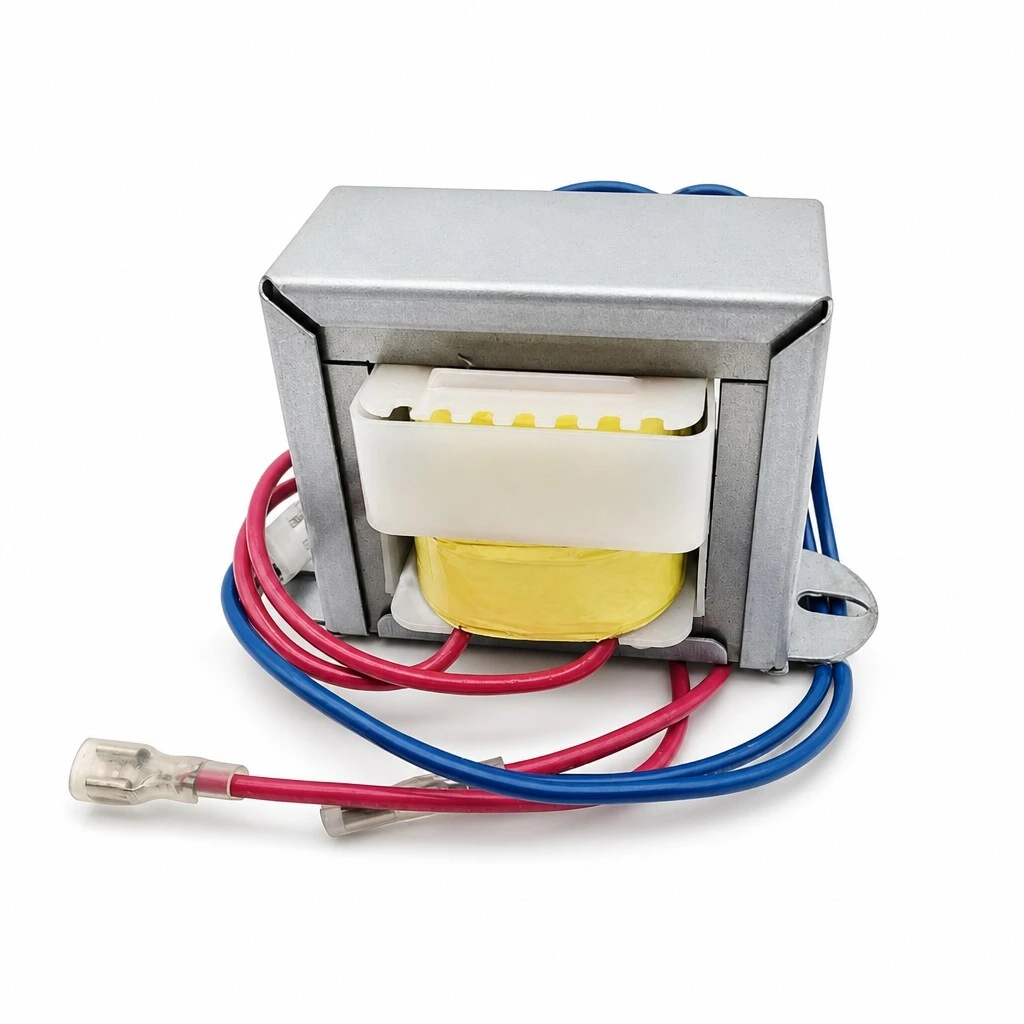
EI41-66-80W 80W Audio Power Transformer AC 220V 50Hz to Dual AC 12V-0V-12V 3.3A Shielded Chassis Mount
A mains transformer for a linear audio supply, built into its own shielded case. It takes 220 V 50 Hz on two red leads and returns a centre tapped 12 V-0-12 V winding rated 3.3 A on three leads, so one part can feed a split supply or a pair of rectifiers. The 80 W is the load it is wound for, and what the amplifier does with the two 12 V halves decides the current each one actually carries.
- 80 W rated, 220 V 50 Hz primary on red-red leads, 12 V-0-12 V at 3.3 A on blue-black-blue.
- Centre tap on the secondary: three leads give two 12 V halves or 24 V across the outer pair.
- Full metal shield can over the core and coil, galvanized frame with slotted chassis brackets.
- High permeability EI silicon steel core, moulded bobbin, combed lead exit.
- Pre-wired colour coded leads, Faston crimp terminals already fitted on the primary.
- No dimensions, weight, regulation, efficiency, insulation class or test voltage is published.
1. Product Name
MYT-66-80W is the model printed on the case label and repeated on the specification panel, and it is the only part code in the material: an 80 W audio power transformer with a 220 V 50 Hz primary and a centre tapped 12 V secondary. The same label gives the lead colours for the input and the output and the manufacturer name, so a unit can be identified from the label alone, without a drawing.
The panel calls it an audio power transformer, and that is the accurate description: a mains transformer intended to sit inside an audio product, not an output transformer and not a signal isolation part. It has no winding in the audio path in the signal sense; its job is to make the DC rails the amplifier runs on. Where a catalogue would normally list a range, the panels show several units of the same build under an OEM and ODM heading, so the model number is the fixed point and the windings are the variable.
2. What It Does
A linear audio supply starts with a transformer because the rails have to be isolated from the mains and because the voltage has to come down before it is rectified. This one takes 220 V 50 Hz in and gives two 12 V halves around a centre tap, so a split supply can be built with two rectifiers and a pair of reservoir capacitors, or the halves can be paralleled for a single 12 V rail at twice the current. The 3.3 A is the current the secondary is wound for at 80 W; how it divides between the halves depends on the rectifier arrangement, which the material does not specify.
3. Construction and Shielding
The build is the ordinary one for a part of this class, and the photographs show all of it. A high permeability EI silicon steel core is stacked through a moulded bobbin, the windings sit on the bobbin behind paper and film insulation, and the core and coil assembly is enclosed in a sheet metal can that is open at the bobbin face. The can is the shield: it closes the magnetic path around the coil and keeps the leakage field away from the rest of the chassis. A galvanized frame wraps the can and carries the brackets, with slotted holes at each end so the part can be fixed to a chassis floor or a side wall.
4. Leads and Terminations
The leads are the interface, and they are colour coded. Two red leads carry the 220 V primary and arrive with Faston crimp terminals already fitted, so the part can be connected to a switch or a terminal block without soldering. Three leads carry the secondary: blue for one end, black for the centre tap and blue again for the other end, which is how the panel writes the output as 12 V-0-12 V. The leads leave the bobbin through a comb that keeps them apart. Their length and their gauge are not stated anywhere in the material.
5. Electrical Specifications
The specification panel is the whole electrical offer and it is four lines long: model MYT-66-80W, input AC 220 V 50 Hz on red-red, output AC 12 V-0-12 V 3.3 A on blue-black-blue, rated power 80 W. The case label repeats the same four facts. There is no regulation figure, no efficiency, no no-load current, no temperature rise, no insulation class, no dielectric test voltage and no insulation resistance, so the part can be specified by its windings and by nothing else.
5.1 The published set and what follows from it
| Parameter | Value | Note |
|---|---|---|
| Model | MYT-66-80W | On the case label and the panel |
| Input | AC 220 V, 50 Hz | Red-red leads |
| Output | AC 12 V-0-12 V, 3.3 A | Blue-black-blue leads, centre tap |
| Rated power | 80 W | The only power figure given |
| Mains frequency | 50 Hz | Only 50 Hz is stated |
| Secondary voltage | 24 V across the outer leads | Derived: 12 V plus 12 V |
| Apparent power | 79.2 VA | Derived: 24 V times 3.3 A |
| Primary current at rating | about 0.36 A | Derived: 80 W at 220 V, not published |
6. Measured on the Bench
One photograph shows the part connected to a power analyzer: 230.07 V rms in, 0.142 A rms drawn, 32.41 W, power factor 0.987, at 50.00 Hz, with an oscilloscope trace of the primary voltage and current behind it. The mains in that room was above the 220 V rating, and 32.41 W is about 40 percent of the 80 W rating, so this is a partial load reading rather than a full load test. It shows the part drawing a sane current at a near unity power factor; it does not give an efficiency, a regulation or a temperature rise.
7. Mechanical Data
No dimensioned drawing is included in the ten panels, and no dimension is printed on any of them. What can be seen is the shape of the case, the position of the brackets and their slotted holes, and the fact that the bobbin face is open at the front. The case outline, the mounting hole spacing and diameter, the height over the can, the lead length and the weight are all absent, and every one of them is needed before a chassis is drilled.
8. OEM and ODM Supply
The panels present the part as one build inside a custom range: an OEM and ODM heading over a group of units of the same construction, with direct factory bulk supply stated under it. That is a statement about how the parts are sold rather than a second specification, and nothing on the group panel is dimensioned or rated. Treat the range as evidence that the same construction is offered with other windings on request, and treat MYT-66-80W as the one build the numbers describe.
9. Quality and Compliance
The compliance panel shows four marks, CCC, CE, RoHS and UL, under a heading about international quality certifications and standards. RoHS is a substance restriction rather than a safety approval, and the UL mark is shown without the Recognized wording that a component recognition normally carries. No certificate number, standards reference or test report is reproduced with any of the four, and no dielectric or insulation figure appears on the same panel.
| Item | Statement | Note |
|---|---|---|
| Dielectric test | Not stated | No test voltage published |
| Insulation resistance | Not stated | Not published |
| Insulation class | Not stated | Not published |
| CCC | Mark shown | No certificate number |
| CE | Mark shown | No certificate number |
| RoHS and UL | Marks shown | No certificate number, UL not marked Recognized |
10. Feature
80 W in a shielded can. The rating is the winding and the can is the shield, and both are visible in the photographs rather than only on a label.
Centre tapped secondary. Three output leads, blue, black and blue, give two 12 V halves around a common tap, or 24 V across the outer pair.
Pre-wired and colour coded. Red for the 220 V primary, blue and black for the secondary, with Faston crimp terminals already fitted on the primary leads.
EI silicon steel core. A high permeability EI stack, called out on the construction panel, with the windings on a moulded bobbin behind film insulation.
Chassis mounting. A galvanized frame with slotted brackets at both ends, so the part bolts to a chassis floor or a side wall without an extra cradle.
One code, one build. MYT-66-80W is printed on the case label and on the specification panel, so the part can be ordered by code without a drawing attached.
11. Advantage
It keeps the mains out of the audio ground. The primary is isolated from the secondary by the winding itself, so the audio ground is not tied to a mains conductor.
One part makes a split supply. The centre tap is what allows two rails from one transformer, which is smaller and cheaper than two separate parts and one more chassis cutout.
The case does two jobs. It shields the coil and it is the mechanical interface, so the part needs no separate screening can or mounting cradle.
The leads are the connector. Faston terminals on the primary and flying leads on the secondary mean no terminal block on the transformer body.
A published model number. Unlike parts sold by description alone, this one can be quoted, cross referenced and reordered by code, which is what an OEM build needs.
12. Specifications
Values are transcribed from the supplier panels. Where a figure is absent the cell reads Not stated, and where the material is silent about a feature the gap is named rather than filled. Rows marked derived are arithmetic on the published numbers.
| Item | Specification | Note |
|---|---|---|
| Product | Audio power transformer, enclosed | Mains transformer, not an output transformer |
| Model | MYT-66-80W | Printed on the case label |
| Input | AC 220 V, 50 Hz | Two red leads |
| Output | AC 12 V-0-12 V, 3.3 A | Three leads, centre tapped |
| Rated power | 80 W | Consistent with 24 V at 3.3 A |
| Core | EI silicon steel, high permeability | Grade not stated |
| Shield | Full metal can over core and coil | Called out on the enclosure panel |
| Mounting | Galvanized frame, slotted brackets | Hole spacing not published |
| Termination | Colour coded leads, Faston crimps | Lead length and gauge not stated |
| Dimensions | Not stated | No drawing and no dimension callout |
| Weight | Not stated | No figure published |
13. Application
The uses below are the ones the material points at, with a note on why a centre tapped 12 V winding fits each. They describe where the part is sold, not a qualification of any one build.
Linear amplifier supplies. A 12 V-0-12 V secondary is the usual shape for a small split rail feeding an audio power stage.
Powered mixers and consoles. Where a low rail and a symmetric rail are needed in one chassis from one mains connection.
Active loudspeakers. One mains transformer inside the cabinet, with the rectifier and the capacitors on the amplifier board behind it.
Preamplifiers and converters. Where 80 W of headroom is far above the load and the shielding is the reason the part is chosen.
Bench and test equipment. A split rail for op-amp circuits, with the can keeping the field off nearby signal wiring.
OEM builds of the above. The panels present the part as one winding inside a custom range, so other primary and secondary combinations are the normal way the range is used.
14. Ordering
Send the application and the rail you need first, then the numbers. A usable enquiry states the mains voltage and frequency, the secondary voltage and current per rail, whether the two halves are used as a split supply or in parallel, and the ambient and the mounting position. Ask for the case outline with the hole centres, the lead length and gauge, the insulation class, the dielectric test voltage and the temperature rise, because none of those is published. If the build is close to this one, quote MYT-66-80W as the starting point and list the differences.
On compliance: the panel shows CCC, CE, RoHS and UL and presents all four as covering the part. No certificate number, standards reference or report is reproduced with any of the marks, and the UL mark appears without the Recognized wording. They are reported here as marks and declarations, not as verified certifications. A mains transformer is a safety critical part, so ask for the certificate and the report for the standard your product has to meet before the design is fixed.
Brand / manufacturer: ZXY, Shenzhen Zhixiangyuan Electronics Co., Ltd. http://www.zxycoil.com