


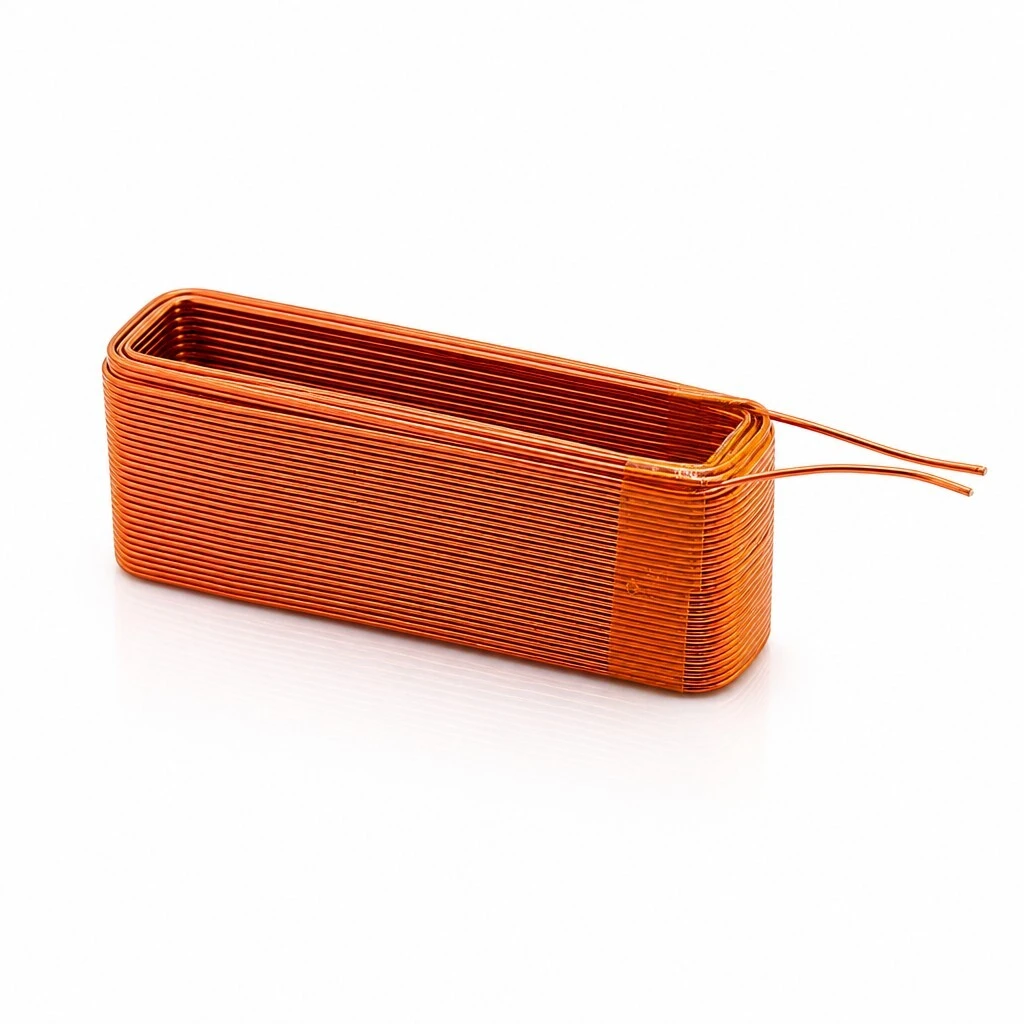
ZXY Flat Air Core Inductor Coil - 0.16 mm Enamelled Copper Wire, 289 Turns | 20.2 x 12.6 x 3.5 mm | 15.6 mm Inner Length | Wireless Power, RFID, SMT
ZXY flat air-core inductor coil — 0.16 mm enamelled copper wire, 289 turns in a flat hollow winding, 20.2 x 12.6 x 3.5 mm, 15.6 x 7.36 mm open centre, stripped and tinned leads.
- 0.16 mm enamelled copper wire, 289 turns, tight flat layer winding
- Air core: no core loss and no saturation, high Q factor at high frequency
- 20.2 ± 1 x 12.6 ± 1 mm outside, 3.5 ± 0.5 mm thick, 15.6 x 7.36 mm open centre
- Leads 20 ± 2 mm, stripped and tinned for direct soldering
- Wireless power, inductive sensing, RFID coupling and compact SMT modules
Size, turns count, wire diameter and lead length can be customised. Full inspection on every batch, RoHS compliant materials.
1. Product Name
ZXY flat air-core inductor coil. 0.16 mm enamelled copper wire, 289 turns in a flat hollow winding of 20.2 x 12.6 x 3.5 mm outside, 15.6 x 7.36 mm open centre, with 20 +/-2 mm stripped and tinned leads.
Identification. The product is supplied under the ZXY brand. No model code is printed on the part and none is given in the source document supplied with this product, so the listing identifies it by construction: flat air-core inductor coil, 0.16 mm wire, 289 turns, 20.2 x 12.6 x 3.5 mm. Quote those four figures when ordering, or ask for a model code to be assigned before the part is specified into a drawing.
The coil is wound on a rectangular mandrel, not on a round one, which is why the outline is a flat racetrack with straight sides and rounded corners. That shape suits boards and assemblies where the coil has to sit flat against a surface or pass over a rectangular target, and it puts more copper in the direction the field is needed than a round coil of the same height would.
2. Feature
Air core, no magnetic core. There is no core loss and no saturation point, so the winding stays linear and the losses stay low at high frequency.
0.16 mm enamelled copper wire. High-purity copper with an enamel insulation that withstands soldering heat at the stripped ends.
289 turns, tight layer winding. A single flat layer, wound evenly so that the turns stay parallel and the field stays uniform.
Flat, hollow geometry. 3.5 mm thick with a 15.6 x 7.36 mm open centre, which keeps the part low on the board and leaves the window free for a target, a core or an air gap.
Stripped and tinned leads. 20 ± 2 mm leads are stripped and tinned, so the coil can be soldered directly without further preparation.
Tape-secured winding. An insulating tape band holds the winding and keeps the layer from spreading in handling.
Custom winding available. Size, number of turns, wire diameter and lead length can be changed to suit the circuit.
3. Advantage
No core loss. All of the loss is copper loss, so efficiency does not fall away at high frequency the way it does in a laminated or ferrite part.
No saturation. The inductance does not collapse at high current the way a cored inductor does, which keeps the behaviour predictable under drive.
High Q in the working band. The air core with a single flat layer gives a high Q factor at the frequencies these coils are used at.
Low profile. 3.5 mm thickness and a flat footprint let the coil sit under or beside other components.
Open centre. The hollow window can accept a core, a sensing target or a shaft without redesigning the coil.
Direct soldering. Stripped and tinned leads remove a process step at assembly.
The practical consequence of the air core is predictability. A cored inductor changes value as the core approaches saturation, so the circuit behaves differently at low drive and at high drive, and the difference has to be characterised. This winding does not have that knee: its inductance is set by geometry alone, so the value measured on the bench is the value in service. The same property removes core loss from the heat budget, which matters in a sealed enclosure where there is no airflow to carry heat away from a small part.
4. Application
Wireless power transfer. Transmitter and receiver coils in inductive charging pads, where a flat air-core winding is the standard choice.
Smart sensing. Inductive proximity and position sensing, where the coil forms one half of the sensing pair.
RFID and signal transmission. Antenna and coupling coils for RFID readers, tags and short-range signal links.
Precision SMT modules. High-frequency and low-loss windings inside compact modules and sensor boards.
Custom wound components. Any application that needs a specific turns count and window size rather than a catalogue value.
In a wireless power link the coil is one half of a coupled pair, and both halves are usually flat air-core windings of this shape, so the pair is matched by geometry rather than by core material. In sensing the coil is driven and the shift in its field as a metal target approaches is read as a position signal; an air core keeps that response linear over the travel. For RFID and short-range links the coil is the antenna, and the high Q of a single flat layer widens the usable band.
5. Application Specifications
5.1 Construction and electrical data
| Parameter | Value |
|---|---|
| Product type | Flat air-core inductor coil |
| Coil structure | Flat wound / hollow coil |
| Core type | Air core (high Q factor) |
| Winding material | Enamelled copper wire |
| Wire diameter | 0.16 mm |
| Number of turns | 289 turns |
| Inner length | 15.6 mm |
| Customization | Custom size / winding / wire configuration |
5.2 Outline dimensions (unit: mm)
| Dimension | Value (mm) |
|---|---|
| Outer length | 20.2 ± 1 |
| Outer width | 12.6 ± 1 |
| Coil thickness | 3.5 ± 0.5 |
| Inner length | 15.6 ± 0.5 |
| Inner width | 7.36 ± 0.5 |
| Lead length | 20 ± 2 |
5.3 Notes on the data in this listing
6. Quality & Testing Assurance
Every batch is fully inspected and held to strict quality control. Appearance, winding count, wire diameter, outline dimensions and lead length are checked against the drawing, and the tape band and tinned lead ends are checked as part of the same inspection.
Materials are RoHS compliant and meet the environmental directives applicable to the destination market. Custom size, winding and wire configuration are available, in which case the drawing issued for that order becomes the inspection reference.